
Every Californian should know California family law.
Whether you are going through a divorce or simply want to understand your rights, our plain-language guides — and the best-selling California Family Law textbook by LW Greenberg, Esq. — give you the answers.
Two facts that set the ground rules.
- Every state has its own laws. California laws, codes, and rules differ from other states'. For answers to your divorce questions, you must look to California law.
- There is no jury in California family court. Family courts are courts of equity, a distinction that traces back to English common law and that California adopted when it became a state in 1850. A California Superior Court judge decides disputed issues such as alimony, child custody, and property division.
Start with the essentials.
These pages give you a solid foundation. For depth on every issue, the full textbook is your next step.
Alimony & Spousal Support
How support is decided, calculated, and for how long.
Read guide →Child Support & Custody
Support formulas, six kinds of custody, and visitation.
Read guide →Hiding Marital Assets
A real case shows why spouses are held to a fiduciary standard.
Read guide →California Property Laws
Six kinds of property and how title is held.
Read guide →Divorce Questions
Real questions with plain answers.
Read guide →About the Author
LW Greenberg, Esq.
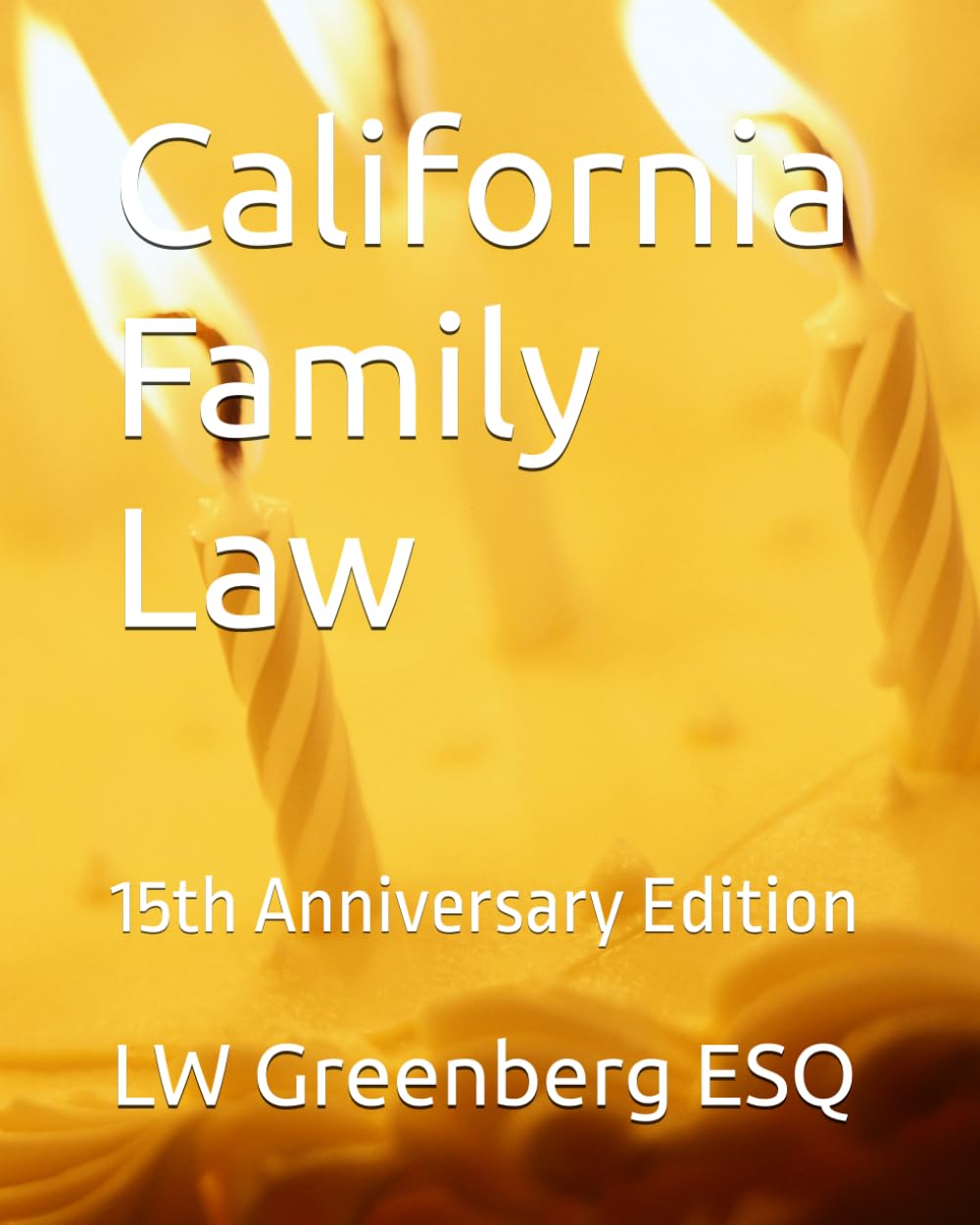
Read guide →California Family Law by LW Greenberg, Esq.
After the guides on this site, this is where you go for depth. A few reasons it stands out:
- Covers every family-law area and issue.
- Written to be easy to read and understand.
- Two tables of contents (brief and complete) and an extensive index.
- 20-page glossary of terms.
- 817 pages of actionable information, reasonably priced.
Already have an attorney? You still benefit — one book answers questions that would cost hundreds of dollars each in billed time.
Unmarried couples living together
Many people believe long-term cohabitation makes them married. It doesn't. California does not recognize common-law marriage. To be married in California you need a marriage license and a marriage ceremony.
There are also no default laws that divide property or award support between unmarried partners — whoever buys property owns it, unless a written Living Together Agreement provides otherwise.
For the full picture, see The Legal Rights of Unmarried Couples Living Together in California by LW Greenberg, Esq.
Nothing on this website constitutes legal advice. If you want legal advice, please consult a licensed California attorney who practices family law.